بستن

safeland.ir@gmail.com       +98 21 88 81 48 12

Archive for category: کاغذ خرد کن

توسط

Case in point

PCSTATS is going to divert from our usual crop of fantastically in-depth motherboard reviews and discuss for a moment, the topic of busted consumer electronics.

China is without a doubt the punching bag of the world when it comes to complaining about electronics that prematurely break, but isn’t this because the overwhelming majority of consumer electronics are manufactured in this country? Now a debate on nationalist manufacturing pride is beyond my pay grade and inevitably everyone walks away angry…. so PCSTATS is going side-step that quagmire and simply pose a question to you.

If your consumer electronics break, what’s stopping you from trying to fix it yourself?

Stop, really think about that question for a moment.

In answering that question, go beyond the superficial stuff and distill the problem down to it’s elemental aspects. I think it fundamentally comes down to having the right knowledge, proper tools and resources (in this case, parts).

As an over-simplified example; if your TV remote control stopped working you would remove the batteries, get new ones and make it work again. In this scenario your hands are the tools, the local drug store is your resource for batteries and your knowledge base tells you that once the remote control’s power supply runs down, it’s time to change it.

My point is, even if you only have two of the three fundamental aspects of this problem covered – say; fresh AA batteries and hands to open up the remote control – you can usually solve the third (knowing the batteries need to be changed). If the warranty is expired and the only alternative is the garbage bin, why not try to fix it yourself?

%image_alt%

Case in point – The Broken Staples Shredder

A few weeks ago our inexpensive $50-dollar Omnitech OT-EMC7A micro cut paper shredder from Staples.ca gave up the ghost and stopped working. Being out of warranty, I took a stab at fixing the wee beastie.

First I checked the simple things; was it plugged in… was the power button on… was the safety interlock switch triggered by the waste paper basket… was there a visible paper jam? With no issues on all these counts I turned to Google and researched common shredder problems. The most common issues were overheating motors and paper jams in the shred feed sensor. Since it wasn’t overheated, the next step was to look for a paper jam inside the Omnitech OT-EMC7A shredder.

Using a phillips screwdriver the fasteners were removed and the case opened up. A pair of infrared LEDs are used in this shredder by the paper slot to sense when paper is being fed in. These LEDs WERE blocked by scraps of shredded paper so I removed that clutter and used tape to seal up the area so the same issue couldn’t reoccur. Unfortunately this wasn’t the problem. The shredder still didn’t work.

%image_alt%

The next step was to check the internal wire harnesses for loose connections. After that failed to resolve the problem, I worked backwards from the power plug (*while unplugged*) to check the functionality of the primary power switch and safety interlock switch with a simple continuity test. Both worked fine.

%image_alt%

Inside Omnitech’s OT-EMC7A shredder is a small circuit board behind the top switches and a medium sized circuit board with an integrated circuit, a fuse and some relays and assorted electronic bric a brac. I’m far from an expert in electronics so anything beyond checking the continuity of the fuse is usually a challenge. The fuse was okay. Drat.

Up until this point I knew what I was doing. Moving forward I relied on what little I remembered from school electronics classes, the ability to use Google to find information and a $10 digital multimeter.

%image_alt%

The problem as it stood, was this – when power was turned on and paper fed in, the motor did not work and the shredder’s LED status light did not illuminate. As the shredder chassis was open, I could clearly see the TZ-7040M12 high torque motor inside it was rated for 120V/60Hz AC. Given this, I surmised that the medium circuit board was the ‘logic’ for the shredder and that two relays on this circuit board switched the 120v mains power to the motor on and off. ( Incidently, I also checked to see if the motor’s rotor was jammed due to blockage or seized bearings, it was fine. On the side of the motor was small Klixon thermal fuse – another potential switch blocking the motor from powering up – a quick continuity check proved it good. )

With the shedders’ switches, safety switches, thermal safety switch, fuse, infrared LED sensor and motor now crossed off the list potential problem areas I was left with a circuit board about the size of a business card. Replacement electrical components could be pulled from old computer power supplies kicking around the PCSTATS labs, or purchased from a local electronics store…I had a soldering iron and multimeter… What I lacked was knowledge of HOW TO troubleshoot the circuit.

%image_alt%

A bit of research on Google (keyword: fixing broken power supply) quickly led me in the directly of three electrical components as the likely culprits for this shredder failure; the diode, the transistor and the capacitor. Having witnessed many a blown and burst capacitor on computer motherboards I knew what bad capacitors looked like, so scratch that. Since there were no visual signs of catastrophically failed diodes or transistors I needed to know how to test these components on the circuit board. Google led me to useless (paid) About.com entries first, before grudgingly giving up useful information on this page: “Making Electrical Measurements Part 3: Testing Diodes and Transistors”.

In my previous research looking for causes of dead power supplies, more than a few service technicians had taken the time to write about their experiences and point fingers at bad diodes as the leading cause of faulty power supplies. Could a bad diode in the rectifier circuit be at fault? Everything on the 120V side of the circuit checked out OK. A rectifier converts alternating current (AC) into direct current (DC) and is usually made up from four diodes arranged a certain way. If that part of the circuit was at fault it would certainly prevent the status LED from lighting up – the only visible clue I had to work with aside from the motor itself.

%image_alt%

As there was a bit of discolouration to the circuit board substrate around a pair of diodes connected to the 120V trace, I set about testing these components as described on “Making Electrical Measurements Part 3: Testing Diodes and Transistors” with a multimeter. Diodes only allow electric current to flow one direction while blocking it from flowing in the opposite direction. Sure enough, both diodes tested BAD!

The two bad diodes were unsoldered from the circuit board and replaced with similar diodes pulled from an old computer power supply. The shredder was powered up and low and behold… it worked once more!

It cost $0.00 to replace those two bad didoes. Not having to buy a new shredder saved $50-bucks and a cubic foot of landfill somewhere in North America. I call that a win even if this challenge did take a couple hours one evening to work through.

%image_alt%I’ll caveat this fix by admitting I still don’t know enough about circuits to troubleshoot them, I got lucky. By working backwards I was able to fix a relatively simple issue by process of elimination. It’s quite possible that the bad diodes were a symptom of something else and not the cause of the shredder’s failure. It’s also true that a little bit of knowledge can be dangerous. If I hadn’t taken a couple years of fundamental electronics classes in school I could have carelessly electrocuted myself with 120V AC.

The point of this editorial is not to guide you through how to fix a dead Omnitech OT-EMC7A shredder from Staples.com, it’s merely to drive the point home that in today’s world there’s no reason not to TRY and fix busted consumer electronics if your only alternative is the garbage bin.

We all have different capabilities and skills, sure, but with a little common sense, a good measure of due diligence and access to the knowledge base that exists on the internet, quite a lot is possible. If you have the tools and resources, chances are good with a bit of research you can track down the knowledge.

Got feedback? We’d like to hear what you think, drop me a line here.

Find out about this and many other reviews by joining the Weekly PCSTATS Newsletter today! Catch all of PCSTATS latest reviews right here.

توسط

Paper Shredder Machine by Zigzag Cutting System

Paper Shredder Machine by Zigzag Cutting System

Paper Shredder Machine by Zigzag Cutting System

Paper Shredder Machine by Zigzag Cutting System – The use of paper in the world today has reached a very high number. In response, the government plans to become the world’s largest producer of pulp and paper. The problem is the manufacturer of pulp and papers in the country in the wood in general the use of forests as raw material. Continuous Recording cause many problems, especially deforestation and depletion of forest resources and forest area in Indonesia. Therefore, it is necessary to find alternative materials for raw materials, such as recycled pulp paper.

The reuse of waste paper as raw material for the paper is also an alternative to overcome the original paper shortage of raw materials and pulp increasingly expensive. We can collect a paper waste from various sources, such as offices, homes, waste disposal, among others. Paper waste is a potential source of fiber and has a strong economic outlook. Before becoming the raw material of scrap paper first destroyed using a paper shredder. Paper destruction process will ease the process of recycling and disposing of waste from office documents will be more secure because it can prevent the abuse of documents.

In terms of cutting system, there are two types of shredder used in some companies cut linear system and zigzag cutting system. System produces paper straight cut noodles while cutting system produces zigzag bands. In this post, we will describe about a Paper Shredder Machine by Zigzag Cutting System because it can produce smaller pieces.

Construction of Paper Shredder Machine

Generally, paper shredder machine by zigzag cutting system consists of three main parts: cutter system, transmission and construction with machine parts as in the image below.

Paper Shredder Machine - Machine Part and Construction

Basic Concept of Paper Shredder

Paper shredder is a tool that works with some of the main shaft on two cutting blades rotating in the opposite direction to destroy the part that goes between the two sets of blades. This type of system uses a paper-cutter that produces the zigzag shape of a rectangular piece of paper.
.
Paper Shredder Concept

Paper Shredder Function

Generally paper shredder works to destroy HVS A4 size sheet of paper, the largest weight of 80 g, a most of 10 sheets per cycle and produce custom pieces of paper 30 x 5 mm. The transmission system in a paper shredder function electric motor delivers power to the cutting system and reduces the electric motors rotation to suit the needs of a knife rotation to destroy the paper.

Machine Principle of Paper Shredder

Paper shredder work by force or power obtained from the electric motor. Power transmission from electric motor to the cutting system uses a gear transmission. Gears transmission system is using spur gear and helical gear so its ratio is not possible to use a high ratio. For a large enough proportion of the complete transmission of transmission systems designed using several levels of the helical gears 1, 2 and 3 transmission uses spur gear transmission. Throughout the transmission system, the output power can rotate the cutter head according to the desired rotation. The system uses two sets of blades which rotate in opposite cutting directions.

Round cutter blade will pull paper that goes through the funnel feeder on the top cover. Paper passes cutting blade will cut off vertically like a wall cutouts by second knife, then cut off horizontally like torn by a knife-edge.

Operations of Paper Shredder Machine

How to use paper shredder includes:

  1. Put the container box at the place correctly.
  2. Connect the power cord to the terminal.
  3. Press the power button to turn on the engine.
  4. When the switch is on, turn the blade and never include metal objects or other hard objects in the judicial system.
  5. Put HVS A4 up to 10 sheets per process.
  6. If the jam, press the switch to turn the paper otherwise REV blades recovered for destruction. Then press the power switch and insert the paper.
  7. Paper destroyed will gather in the box reservoir.
  8. Turn off by pressing the OFF put.
  9. Remove the destroyed paper, if in the reservoir has been filled

That is a description about the Paper Shredder Machine by Zigzag Cutting System. If you find misconceptions in this post, please give correction in the comment box.

How to design of shredder blade, power requirement and other part of paper shredder machine, I will explain in the next article titled paper shredder design

توسط

ساخت کاغذ خرد کن

Hand Cranked Document Shredder

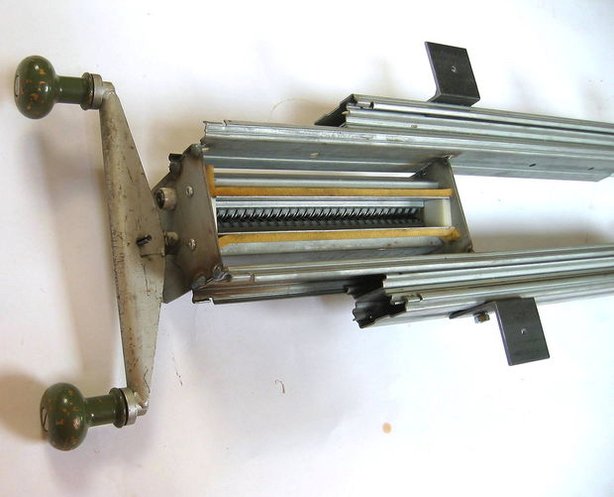
This hand cranked paper shredder is really satisfying. It’s on a cool double-drawerslide disappearing bracket. It sounds like loading a machinegun when you pull it out. Once someone starts shredding you can’t stop them til the scrap paper is all gone.

Much skillful photography, craftsmanship, video editing, etc by Fungusamungus


Step 1: Plot summary up to this point…

Plot summary up to this point...
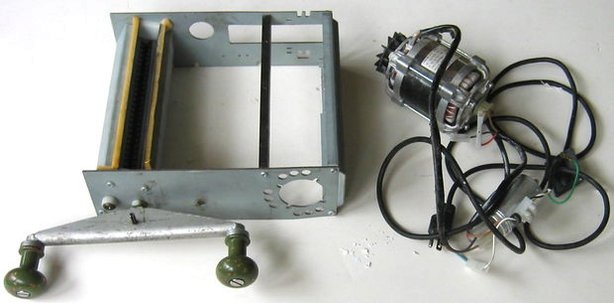
Someone took apart their electric shredder and left the parts in a pile.
“Bicycle powered shredder” thought I. First I would try it by hand just to get a feel for it.
I had a crank handle from an astronaut-torturing machine that happened to fit over the shredder’s drive shaft.
There was a hole for a retaining pin in the driveshaft. I drilled the crank to match, pounded in the pin, and Voila! Hand-cranked shredder.
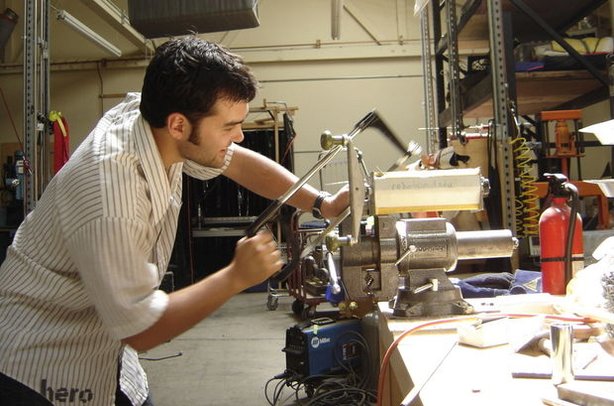
Then I clamped it to a table and everyone started shredding documents until we couldn’t find any more paper.
It all happened so fast I didn’t take pictures of the steps, but your junk shredder and your crank will most likely
be totally different. Try a handle from an old meat grinder or a crank from a bicycle.
Hand shredding is so satisfying and convenient I don’t know if I’ll make the pedal grinder.
If you do it let me know how it turns out. Next came the process of fitting it under a table in just the perfect way. Continue…
 

Step 2: Saw off the Extra Stuff

Saw off the Extra Stuff
Fungus hacksaws off some legacy sheetmetal.
My granddad used to say: To carve a wooden bear take a piece of wood and cut off everything that doesn’t look like part of a bear.

Step 3: Two Double Drawerslides

Two Double Drawerslides
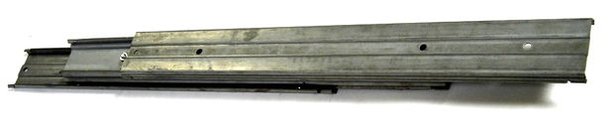
After much harrumphing we decided to bolt two drawerslides face-to-face like this and weld one such assembly on each side of the shredder. That would get it to extend and retract as far as we needed.

Step 4: Setting up the Assembly

Setting up the Assembly
We put the whole thing together with clamps and blocks so we could weld it properly.
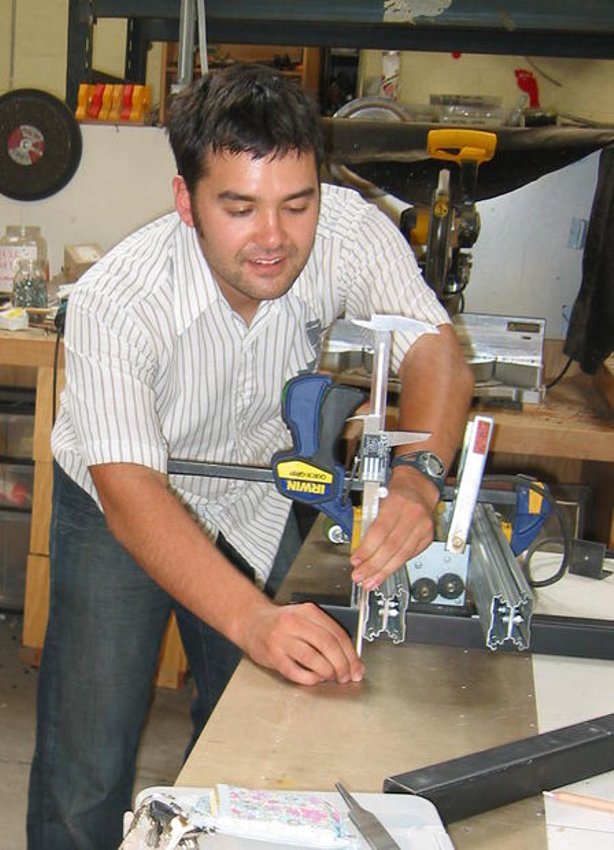
The slides needed to be level and parallel. Fungus mikes out our tolerances.

Step 5: Weld it Together

Weld it Together
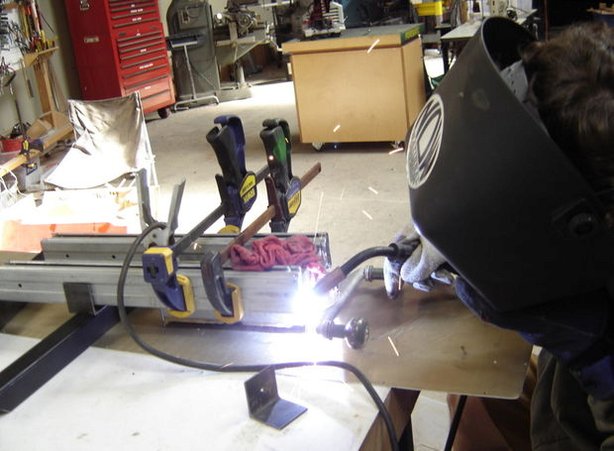
The tricky part was welding it without melting the plastic bearings on the shredder.
I draped a soggy wet rag over the metal between the weld and the plastic bearings. Then after welding I mopped at the hissing welds to chill them as soon as I could without cracking them.I used the shop’s wirefeed welder. To make welding easy, use Miller’s online welding calculator to find out what amperage, gas pressure, wire feed rate, etc. for the material and type of weld you’re doing.

Step 6: Bracketizing Step One: Rough Marking

Bracketizing Step One: Rough Marking
I found four small iron angles in the stock pile. Perfect to attach our device under a counter.
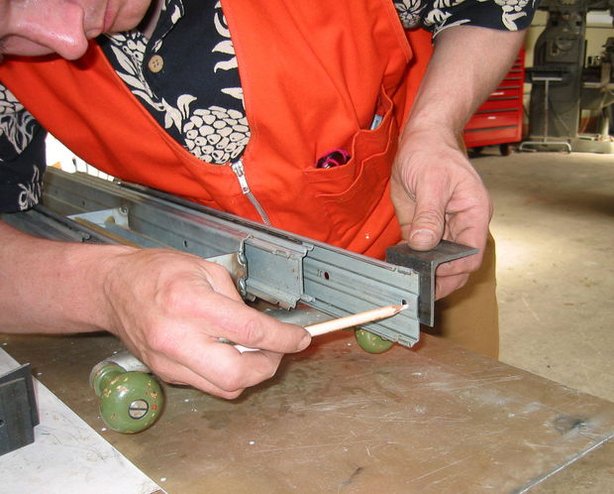
They needed additional holes. Here’s how “shop guy” does that. Setup your assembly with clamps or by hand and mark where the mating hole will go.

Step 7: Bracketizing: Cross Scribing with Caliper

Bracketizing: Cross Scribing with Caliper
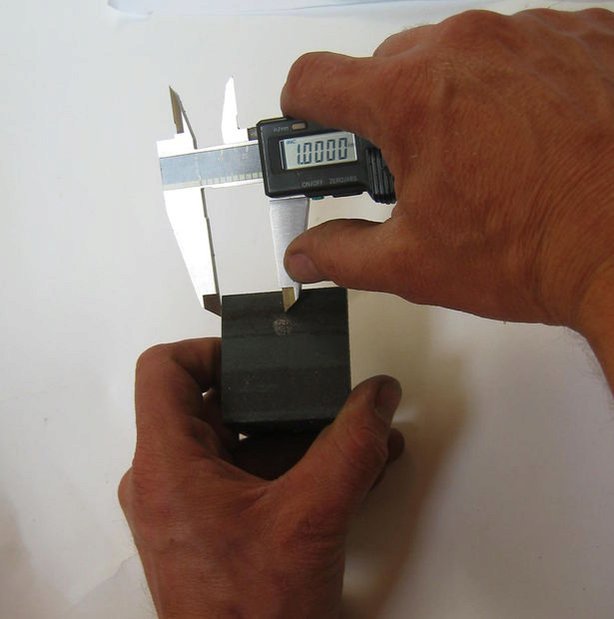
Choose two edges as “reference edges” and set your caliper to the desired distance. The caliper has hard sharp jaws that make a good scribe. This is an approved technique.
Scratch two lines that cross where you want your hole.

Step 8: Finding the Center

Finding the Center

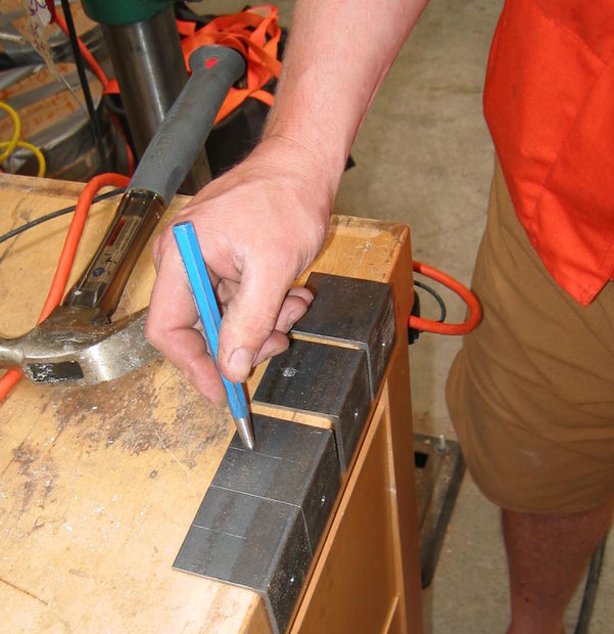
Take your center punch and run it along one of the scratches until the tip drops into the deep spot where the two grooves cross.

Get an old Industrial Arts textbook. It’ll have these tricks and more.

Step 9: Center Punching

Center Punching
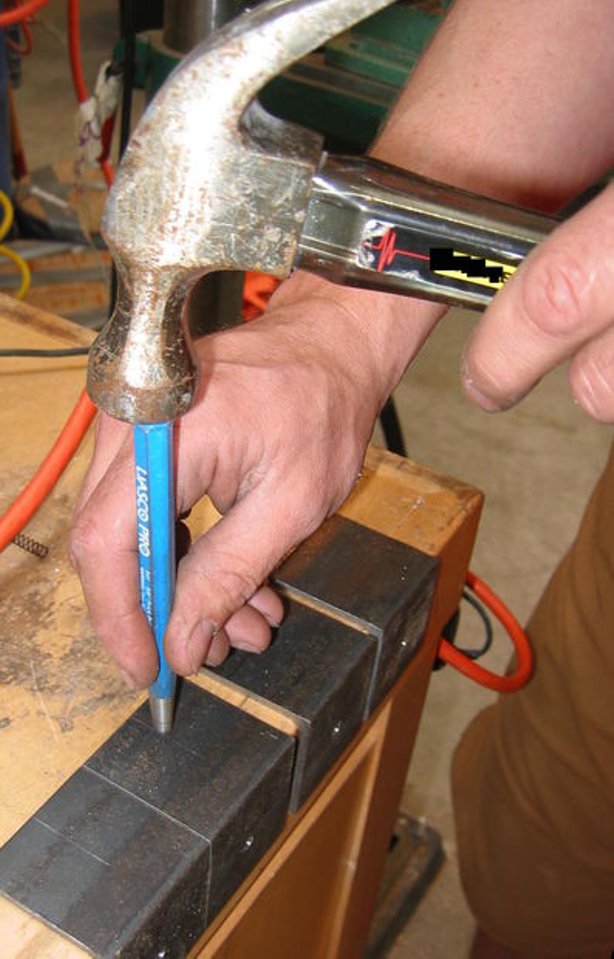
Hit your center punch once with a hammer. Hit it as vertically as possible. Look at your centerpunch mark.
Your eyes will be pretty accurate. If you don’t like where it is you can push it around by centerpunching at it from an angle.

Step 10: Lube Your Bit With a Candle

Lube Your Bit With a Candle
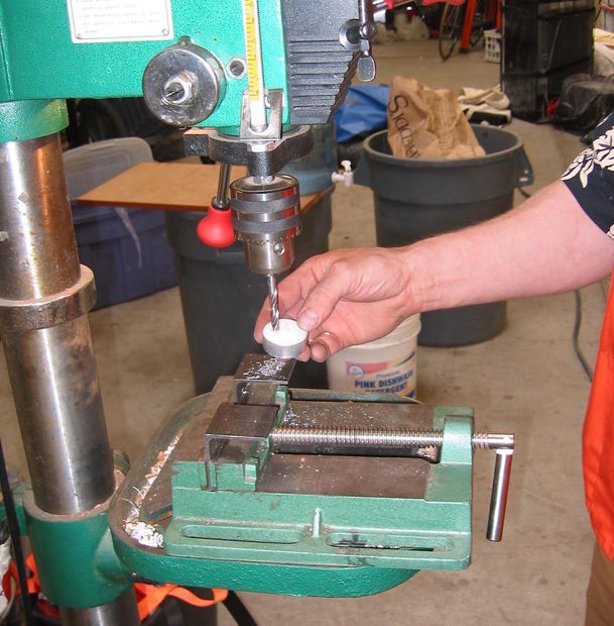
Soft wax like beeswax or microcrystalline wax is best, but all I could find was this paraffin candle. I like wax better than oil because it makes less of a mess and picks up the chips well. When the wax melts it’s a fine oily lubricant.

Step 11: Drill the Hole

Drill the Hole

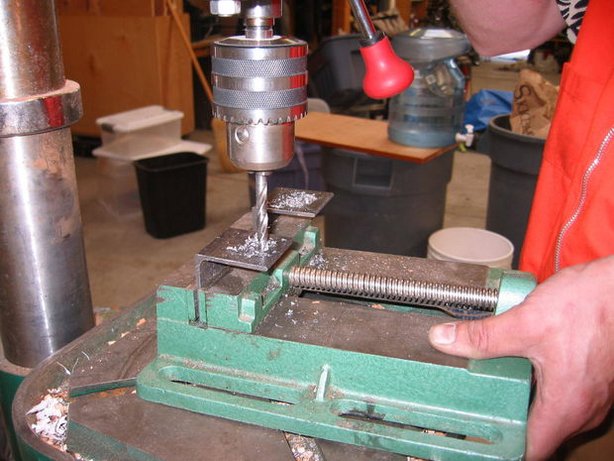
Consult your industrial arts textbook for proper info on drill sharpening, tool speed, and feed rate. It varies with the material. It’s interesting how a drill, saw blade, and lathe bit have similar cutting parameters.

Small pieces must be clamped or the drill will bind, spin them, and mess up your hands.

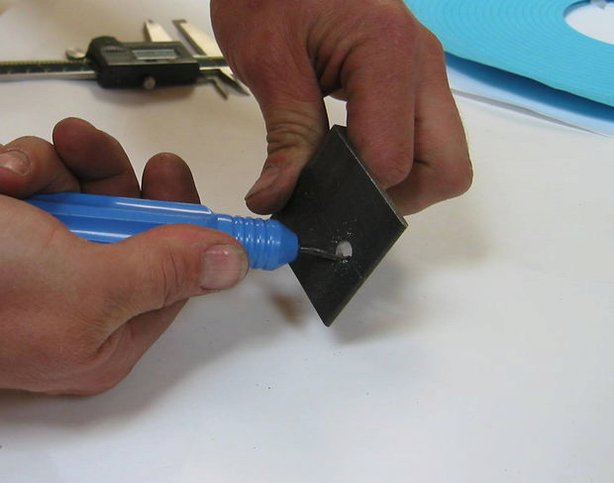
Step 12: Deburring Tool

Deburring Tool
Not really a necessary step in this case, but it’s fun to do. Get a cheap deburring tool from Wholesale Tool or MSC. It’s especially good for cleaning up cut tubing ends.

Step 13: Houston, we have Brackets

Houston, we have Brackets
Here’s the completed assembly, in “out of battery” position.

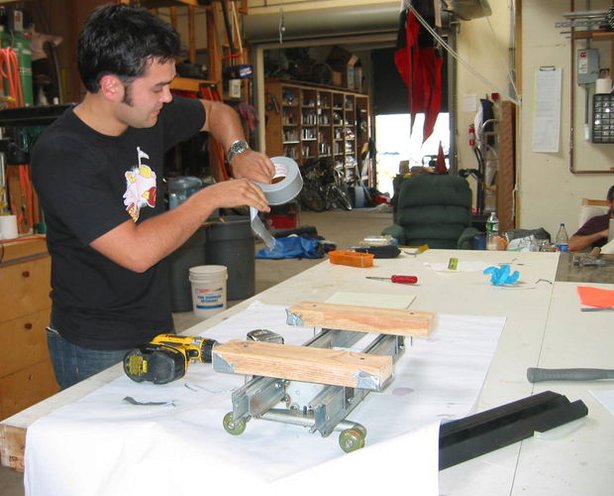
Step 14: Standoffs

Standoffs
The counter we wanted to mount the unit under has a lip around it, so we added these 2×4 chunks as standoffs. I would have just juggled, dropped, and cursed, but Fungus had the bright idea to duct-tape them in place temporarily.

Step 15: Pattern and Mounting Holes

Pattern and Mounting Holes
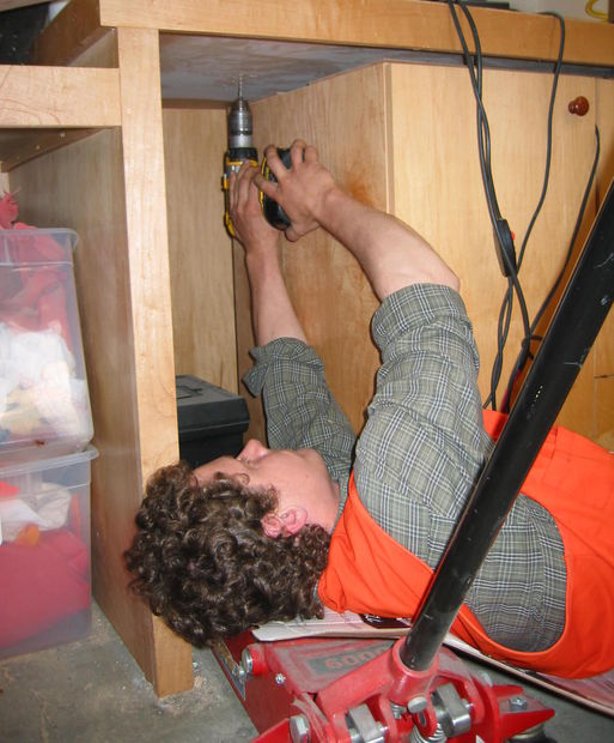
We laid a piece of paper over our brackets and poked through it where the mounting holes were. We used this pattern to mark where the holes went under the counter. Then we drilled undersized holes for the screws to bite into.

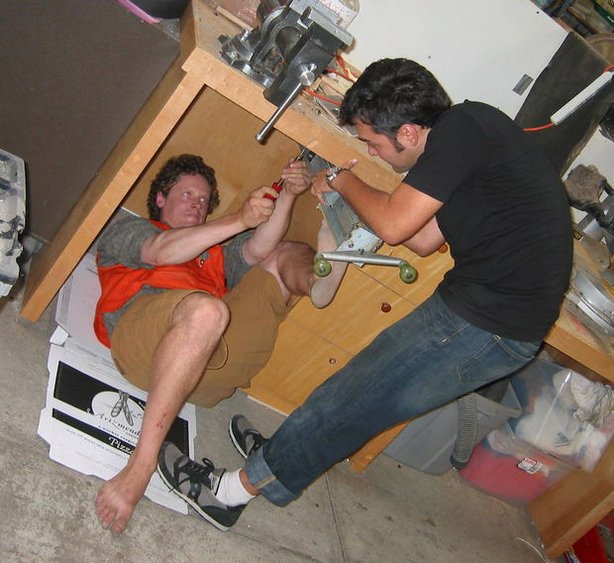
Step 16: Bolting it On

Bolting it On
This was probably the hardest part of the whole process. We tried it in another location first, but there just wasn’t enough room under it for a human to work properly. We gave up and put it under this more spacious counter.

Step 17: In Action

Here’s a movie of the shredder in use

Step 18: The Shred Bed

The Shred Bed
Once you’ve shredded your documents what next?
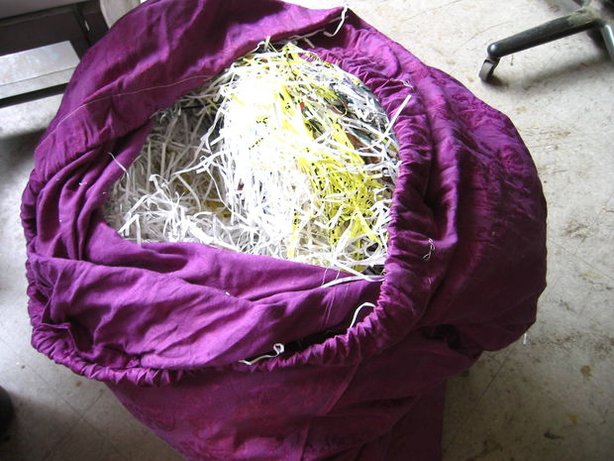
How about using the shreds to make your own improvised futon?
For initial tests we used giant drawstring bags. For comparison we filled one bag with crumbled newspapers to make a “crumple bed”. Marion tests them out. Conclusions: It takes a huge quantity of stuffing to make a futon. The crumblebed is lumpy, not as good as the shred bed. The shred bed is very comfortable. Marion had just finished one of her final exams and took a nap right there.
توسط

POWER DRIVEN SHREDDING HEAD

POWER DRIVEN SHREDDING HEAD

We will be experimenting with different shredding heads, some examples of which are seen below. They almost all use hardened steel cutting blades. It remains to be seen which will be the most (cost) effective.

Initial trials will revolve around a simple planing head as used on most hand-held wood planers. These rotate far too fast for our purposes, and are typically driven by a universal AC motors powered directly from the mains. We will be replacing the AC motor with a 24 volt DC drive, going through a reduction gear-train to give us around 900-1200 revolutions per minute. We may incorporate a safety clutching feature for these trials.

We will incorporate sensors to detect fish movement in the ponds that we are using for tests, that will cut power to the rotating heads. On the full size vessel, more sophisticated fish detecting apparatus is to be used, such as an enhanced fish-finder. Something fishermen could not do without today. A fish finder is a specialized kind of sonar. Sonar is also used by submarines, to track other submarines and ships.


This is a commercially available shredding box costing less than £40. The cutting teeth on the right are assembled over a driven shaft, much the same as some of the industrial shredders that we have been looking at costing thousands of £ pounds.


Another approach is to use a single rotating drum with tungsten steel blades. Drums are available with a helical blade at greater cost. To begin with we will try both methods – to compare with the results from the toothed shredder above. Whatever system is used, it must be capable of dealing with rope and netting as well as plastic solids – to scale of course. This is academic research for which we do not qualify for funding, confirmed to us today (15-1-15) during a telephone conversation with the NERC. We may thus be forced to cease our efforts and hand this side of the project to a not-for-profit concern – like Max Energy Ltd.


Enter the dragon. This helical planing head suggests a new dimension when it comes to reliable shredding of plastic waste. Certainly, the tungsten carbide cutting blades will last longer and only need local replacement, instead of the full length blades in older rotating systems. But, how much?


SENSORS & MACHINE CONTROL

We can’t say too much about this aspect of the research at the moment because of IP restrictions. Suffice to say that the full size craft must be capable of detecting plastic in seawater and also know when organic life is present. Once the plastic size is known, we can re-configure the filtration plant autonomously to extract that size. This requires an electronic feedback loop to control the machinery for maximum efficiency harvesting. Easy-peasy. We also need to be able to ward off curious fish and rescue animals caught up in fishing nets. How do they do that? Sorry, IP forbids. But it is very much on the cards. Our conceptual designer generally figures these things out without too much grief.

SeaVax ocean cleanup project business cards


Industrial shredders come in all shapes and sizes. They can deal with just about anything, from tires to fridges, but at a cost. The above machines weigh quite a bit more than we’d like, but of course, you cannot have a sturdy shredding head without a mass compromise.


PLASTIC MINI MILLS – These are mini shredders – to be able to recycle plastic at home. They can easily handle Lego blocks, bottle caps and cups. With just a slight adjustment in size downwards they would be ideal to test out our model in 1/20th scale. But they look expensive.

توسط

تبدیل کاغذ خرد کن برقی به دستی

Hacking an electric paper shredder

 
My aim in this task to use an old paper shredder and make it into something that was powered by hand and that could cut my plastic in pieces.
Step 1: Taking apart the shredder and removing the electrics and motor and all the casings.
I stripped away any components that were not needed for the use of hand-powering.
Step 2:  Above is the key element that was attached to the motor so therefore what makes the whole shredder blades turn.   So I made a key out of brass to fit this hexagon shape. 
Then riveted the key to a wooden handle.
Step 3:  Housing the shredder temporarily in a cardboard box.  The lid flaps of the box turned in made a double layer of cardboard and a stronger structure.  It also allowed me to cut into the sides at different depths so giving a strong support for both sides of the shredder.  I  had to accurately measure the sections to cut to make sure there was no movement and that it wouldn’t fall out.
Step 4: I Attached the handle on the outside securing it with the shredders original Circlip. 

   A it works!  The only problem is that it cuts paper well but the blades are not sharp enough, or close enough to cut the plastic! Instead of cutting it perforates the HDPE and PP.   I then continue to sharpen the blades with a sharpening stone but it still doesn’t cut.

توسط

خرد کن های ماشینی

Shredder Machine
Industrial Shredder
Twin Shaft Shredder
Paddy Straw Shredder
Paddy Shredder
Cloth shredder
Waste Cloth Shredder
Glass Bottle Crusher
Bottle Crusher Machine
Cement Roof Shredder
EFB Shredder
Shredder Machine
Paint Sludge Shredder
Biomass Shredder
Tire Shredder
Tire Shredder Machine
Plastic Shredder Machine
Plastic Bottle Shredder
Fabric Shredder
Fabric Shredder
Waste Reduction
Waste Reduction Machine
Bottle Shredder Machine
Metal Shredder
Steel Shredder Machine
Steel Shredder
Steel Scrap Shredder
Cardboard Shredder Machine
Paper Shredder
Paper Shredder
Wood Shredder
Wood Shredder


توسط

خرد کن صنعتی

Industrial shredders

Here are a few of our industrial shredder design features that you need to have and a few of our shredder design features that you must have.

We make real industrial shredders

Ask any “industrial shredder maker” to send you a picture of their industrial shear type shredder that has a 72″ long feed opening at the cutters, and a 72″ wide opening at the cutters, with a 24″ center to center shaft design distance.

Industrial Shredder

Then ask everyone if they sell this machine for $250,000.00. We do…

We know that they don’t sell at this price, their price is $450,000.00…and higher…

Then we suggest that you see how large gearbox drives others put on their industrial shredders.

Industrial Gearbox

This is a picture of our gearbox; we have two of these on every one of our shredders. This gearbox uses a 75 hp electric motor driving the gearbox that reduces the rpm from 1800 rpm down to 6 rpm on the cutter shaft. Ask any other industrial shredder makers to submit a picture of their gearboxes with a man next to them for size comparison.

You will be shocked!

We make industrial shredders, others make toys…

We also design our machines for easy maintenance.

Industrial Shredder Stafshot

Using a modular construction so that everything can be taken apart in less than a day. Ask other shredder makers to show you their design…

We make industrial shredders,other groups make toys…

four_industrial_shredders

This is our Eidal industrial four shredder line, which sells for under 1 million. This design is used to progressively grind materials down properly, one step at a time.

Ask any other shredder group to show you their pictures of their four shredder lines.

They don’t have any four shredder lines.

We are the only group in the world to build such systems.

We build industrial shredders other groups build toys…

See pretty picture below of shredder parts

industrial_shredder_parts

Guess who first invented and even patented many of these design?

We did, starting in 1966 and continuing forever.

Ask the other shredder companies who invented their shredders most of them will lie.

Most of the time we invented their shredders.

Many times our old designs have been copied.

We are industrial shredder makers, others make toys

industrial_shredder_parts_drawing

We give our customers our wear parts drawings.

We want our customers to make their own parts.

We make industrial shredders.

We make parts, but you can also make your own parts to lower your long term operating cost. No one else in the industry does this for their clients, we give you wear parts drawings.

We are a very special industrial shredder maker.

This is one of our small industrial shear shredders.

توسط

اسیاب

Granulator

Granulators

These Granulator machines are designed with high speed, medium inertia, open rotor body, with 2, 3 or 5 hardened steel knives. Granulators can grind material down to 80 mesh or up to 2″ in size. Interchangeable qualifying screens with various diameter holes determine the final reduction size. With decibel ratings of less than 65 Db, these units are ideal for placement at individual work stations. Granulators are sized by the dimensions of the cutting chamber and range in size from 8″ x 10″ to 16″ x 35″. Motor sizes range from 5 HP to 40 HP.

(See chart below for a compete list of machine sizes and technical specifications.)

Complete systems can include air discharge units or conveyors, and can easily be integrated with existing shredder or grinder systems.

(For higher productions volumes, please review our alternative CS Grinder Series.)

Applications

arrow image Plastic granulator
arrow image Plastic shredding – up to medium size purgings
arrow image Security destruction – paper, books, folders
arrow image Pharmaceutical shredder
arrow image General recycling
arrow image Cardboard / heavy paper
arrow image Foam
arrow image Processed rubber grinding
arrow image Glass bottles, metal cans
arrow image Fiberglass
arrow image Rock wool
arrow image Textiles

Double edged granulator knives are constructed from high alloy hardened steel for superior service in any application. Knives are also designed for easy access and adjustment during routine servicing.
granulator knives

granulator screen

Granulator Specifications

Model No. 10×12 14×20 16×35
Height 71 1/2″ 80 3/4″ 81 1/2″
Width 31 1/4″ 41″ 57″
Depth 24 3/4″ 36″ 57″
Throat Opening 10″x12″ 14″x20″ 16″x35″
Stationary Knives 2 2 2
Rotating Knives 2 or 3 2 or 3 2 or 3
Length of Knives 12 1/4″ 20 1/4″ 35 7/16″
Rotor Diameter 11 14″ 14″
Screen Sizes Various Various Various
Screen Area 160 sq. in. 365 sq. in. 638 sq. in.
Cast or Mount Option Yes Yes Yes
Type of Drive V-Belt V-Belt V-Belt
Motor HP 7 1/2 or 10 10, 15, 20, or 25 40, 50, or 75
Air Discharge Option Yes Yes Yes
توسط

چرخ پلاستیکی

Plastic Grinder

Plastic Grinding MachinePlastic is produced in a variety of compounds like HDPE, LDPE, PVC, PET and more. It comes in an even greater variety of shapes and sizes, from bottles, strips, purgings, containers, trays and other plastic scrap. No matter what type or size, one problem has always existed in the world of plastics…

What to do with the plastic scrap, plastic extrusion overruns, purgings, or post consumer plastic? The answer to plastic recycling is simple when you choose a quality grinder by Jordan Reduction Solutions.

Plastic grinder to recycle and reuse plastics

Recycle logoThe 13CSD Plastic Grinder is the perfect machine to handle all of your plastic recycling, size reduction, and processing needs. From plastic pipe, to PVC, or post-consumer plastics, we have the grinding equipment to handle the job.

Plastic Grinder Increases Scrap Reclaim

shred particlesNo extrusion process is perfect. You will always have below spec runs, over-runs and the initial extrusion that is just not up to specifications. There’s no need to pay costly scrap charges and hauling fees to discard this waste. Save money and save landfill space – reprocess your defective or out of spec material or purgings with a JRS Plastic Shredder, grinder, or granulator and reclaim your loss.


After Market Processing

plastic pelletsIf your focus is on reclaiming post-consumer PET, then there is a Jordan Reduction Solutions machine that can do the job right. From heavy duty high production grinders to open rotor granulators, our machines can process your materials and give you the particle size you need for further processing or resale.


Versatility of Design

From the small hand feed operation to complete engineered plastic shredder systems, Jordan Reduction Solutions is your one stop for all your needs. We specialize in custom, application specific plastic grinder systems from several hundred pounds to several tons per hour. Give us a call and let our staff help you determine the most economical solutions for your plastic grinding needs.

Rubber Recycling

Technical Specs for Plastic Grinders

grinder specifications chart
توسط

شفت خرد کن

Rubber Grinder

The Jordan Reduction Solutions Rubber Grinder is the equipment of choice for many industrial rubber compounding and processing facilities. With over 75 years of continuous service to the rubber industry, our Rubber Bale Grinders have proved to be the most efficient and highest production units for grinding various rubber compounds such as EPDM, SBR, NBR, Butyl and many more natural and synthetic rubber materials. From rough grind sizes to crumb rubber.

Versatile Rubber Processing

Most rubber compounds require some lubricating medium during the grinding process to reduce friction and heat. Whether the material requires dry talc powder as a partitioning agent or a fluid slurry, the JRS Rubber Bale Grinder family can accommodate your needs. We offer injection systems for both dry powder and wet fluids to aid the grinding process to facilitate a cooler, more efficient grinding process.

Rubber Recycling

Watch the Rubber Grinder video to see crumb rubber production.

Decreased Batch Mix Time

Your mixer was made to do one thing well – mix your rubber compounds. While many have the ability to break down full or partial bales of rubber; dissolving an 80 pound bale in your mixer isn’t the most cost effective of solutions. Grinding your bales with a Jordan Reduction Solutions Rubber Bale Grinder is the best way to increase the efficiency of your mixing process while decreasing the stress, cost and mix times required for your processing needs. Saving you time, money and prolonging the life of your batch mix equipment.

Metered Feeding

star feed metering system for rubber grinderMetered feeding can be crucial when grinding various rubber bale compounds. Grind too fast and heat issues can devastate the process. Each JRS Rubber Bale Grinder has an optional proprietary metered feed system that grabs the incoming material and feeds it into the rotor at a consistent, adjustable rate, giving you the perfect particle size of crumb rubber for your mixing needs. We call it a “Star Feed System” due to the shape of the feeder blades.


Consistent Particle Size at Higher Production Rates

The JRS Rubber Bale Grinder Series can produce a consistent granule size from 1/4″ and up at production values up to 5 ton per hour. This allows you to choose the particle size that best accommodates your required mixing rates. These ranges make the JRS Rubber Bale Grinder the industry leader in rubber processing.

Customer Listing

Jordan Reduction Solutions Rubber Bale Grinders are serving the rubber industry at some of the worlds largest corporations. The following is a partial listing of those who have and continue to use the Jordan Reduction Solutions RBG units:

  • Goodyear Tire and Rubber
  • Exxon Mobile
  • Chevron
  • Avery Dennison
  • W.R. Grace
  • Rubbermaid RTH Polymers
سایت فروشگاهی